
'Keeping the global temperature below not just 1.5 degree Celsius, even 2 degree Celsius is beyond our reach now. Both are impossible.'

'The food security along the coastal region will be severely affected.'

'We should expect extreme heat, extreme rains, floods, landslides and maybe cyclones. Not just this year, in the coming year as well.'

The conditions that lead to landslides, including soil texture, soil moisture and slope are known, and it is important to put all this knowledge into an operational system, he said.
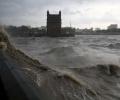
'Each cyclone has its own identity and its own behaviour based on the environmental conditions in the ocean and in the atmosphere.'
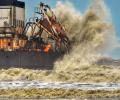
Surface temperatures have increased rapidly during the past century, leading to an increase in the frequency and intensity of tropical storms in the Arabian Sea, reports Sanjeeb Mukherjee.

The first cloud-seeding trial has been conducted in parts of Delhi, including Burari and Karol Bagh areas, aimed at inducing artificial rain to tackle air pollution.

He said scientists have noticed a trend of very deep cloud systems developing over the southeast Arabian Sea, and added that sometimes, these systems intrude into the land, like in 2019.
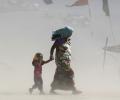
'It is high time that we act instead of just talking about how and why the climate is changing.'

'Storms push a lot of water into land, then there is heavy rainfall due to the cyclone.' 'Along with this, we see the gradual rising of the sea level.' 'We see this during and after the latest Cyclone Tauktae.' 'This kind of overlapping events are increasing and we do not know much about how to tackle them.'

'We will have to face the effects of climate change for generations to come!'

Cyclone 'Biparjoy', the first storm brewing in the Arabian Sea this year, has rapidly intensified into a severe cyclonic storm, with meteorologists predicting a 'mild' monsoon onset over Kerala and 'weak' progress beyond southern peninsular under its influence.

At a virtual press conference to launch the report, Inger Anderson, Executive Director, United Nations Environment Programme, said, "Climate change is here and now. No one is safe. Despite warnings from so many years, the world did not listen. We need to act now. Reducing greenhouse gas emissions will not only limit climate change but also reduce air pollution."

The experts said that climate change is not only raising temperatures and making India's heatwaves hotter, but also changing weather patterns that further drive dangerous weather extremes.
